this page gathers all publications — journal articles, conference proceedings, reports, and posters — I have contributed to during my time as a PhD fellow at the Department of Mechanical and Production Engineering at Aarhus University. Not all pre-prints made it to a journal issue, but they are still here for fellow researchers to browse and seach for.
2026
July
Draft
A directional perspective to mobility mapping and route planning for ground
vehicles
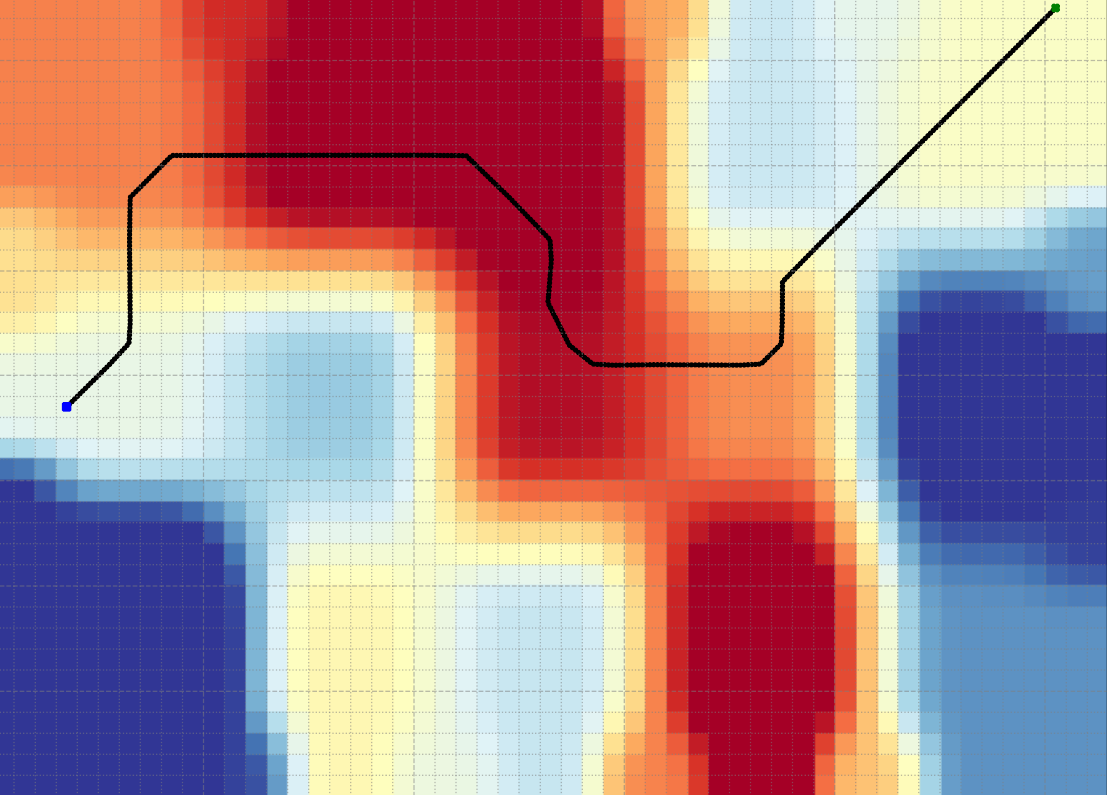
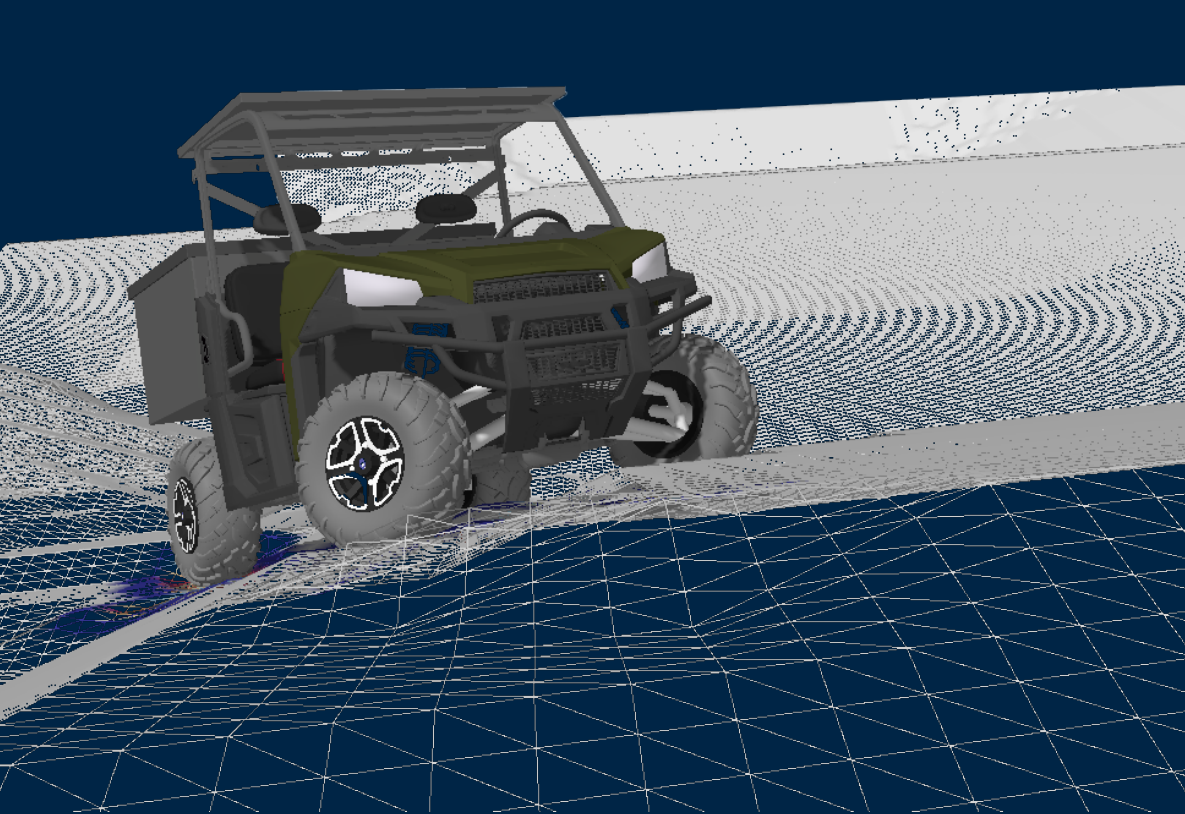
In this paper, we present a novel approach to generating mobility maps for
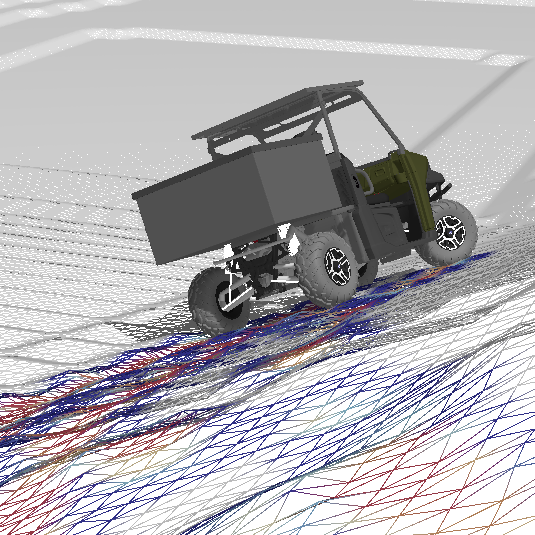
ground vehicles using results from high-fidelity multibody vehicle
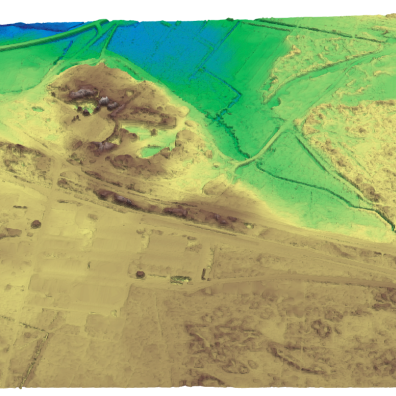
simulation and directional slope information from GIS data. As part of the
study, we demonstrate the framework for a small utility all-terrain vehicle
on data from a challenging terrain in the central Jutland (Denmark)
obtained from publicly-available sources. The performance characteristics
of the vehicle are evaluated in simulation through a minimum set of
mobility events, following NATO standard recommendation STANREC 4813,
capturing grade-climbing capability and side slope stability. Using
processed GIS data, we generate a set of directional mobility maps and
correlate the mobility of the vehicle to the properties of discretized
terrain units. To validate the performance of the directional approach
against its omnidirectional counterpart, we perform path traversal
simulations on synthetic and realistic terrains using straight-line paths
and paths generated by an optimal route planner.
@article{sirangelo_2026directionalperspectivemobility,title={
A directional perspective to mobility mapping and route planning for ground
vehicles
},author={Sirangelo, Dario and Balling, Ole and Petersen, Nikolaj Jes},year={2026},month=jul,journal={International Journal of Vehicle Performance (IJVP)},}
June
Abstract
Two Formalisms - One Course: Computational Dynamics using Absolute and
Minimal Coordinates (SOA)
Ole
Balling†, Oskar
Minds, Melissa Pilegaard Rasch
Nielsen, and Dario
Sirangelo
In
Proceedings of the 8th International Conference on Multibody System
Dynamics (MUSD)
, Seville Jun 2026
Multibody dynamics formalisms, and particularly their numerical
implementation, are constantly evolving. Many software solutions and
libraries exist for their implementation. The adaptation of multibody based
dynamic simulation is showing up in Computer Aided Engineering tools and
other places such as design and controls software, gaming engines, etc.
Therefore, the teaching of methods and their implementation becomes even
more important as young engineers are preparing for their professional
careers whether it being in industry or research settings. This
contribution is a continuation of the work on computational dynamics
teaching presented at the 7th International Multibody Systems Dynamics
conference held at University of Wisconsin in June 2024.
@inproceedings{balling_2026twoformalismsone,title={
Two Formalisms - One Course: Computational Dynamics using Absolute and
Minimal Coordinates (SOA)
},author={Balling, Ole and Minds, Oskar and Nielsen, Melissa Pilegaard Rasch and Sirangelo, Dario},year={2026},month=jun,booktitle={
Proceedings of the 8th International Conference on Multibody System
Dynamics (MUSD)
},location={Seville},}
May
Preprint
DYNO: A validation toolkit for assessing the performance of autonomous
ground vehicles
DYNO is an extensible toolkit designed for the performance validation of
ground vehicles. It builds upon the high-fidelity simulation capabilities
of the Chrono::Vehicle [@serban2019chrono] module of the Project Chrono
[@tasora2016chrono] middleware, a robust and mature open-source
multi-physics library, to provide a diverse set of simulation scenarios of
common interest to scientists, engineers and students engaged in manned and
autonomous vehicle simulation.
@article{sirangelo_2026dynovalidationtoolkit,title={
DYNO: A validation toolkit for assessing the performance of autonomous
ground vehicles
},author={Sirangelo, Dario and Balling, Ole},year={2026},month=may,journal={International Journal of Vehicle Performance (IJVP)},}
Preprint
MOMA: A Python library for the generation of mobility maps and optimal
routes for ground vehicles
MOMA is a Python package designed to streamline mobility mapping from
vehicle performance data. It integrates Geographic Information System (GIS)
raster data to define site specifications and assess how easily,
efficiently, and safely vehicles navigate between locations on a map.
@article{sirangelo_2026momapythonlibrary,title={
MOMA: A Python library for the generation of mobility maps and optimal
routes for ground vehicles
},author={Sirangelo, Dario and Balling, Ole and Petersen, Nikolaj Jes},year={2026},month=may,journal={Journal of Open Source Software (JOSS)},}
Preprint
A multi-step dynamic window approach planner for Ackermann-steered vehicles
The Dynamic Window Approach (DWA) has been one of the most popular
model-based planner for autonomous vehicles for over two decades. Despite
the increase in computational power for autonomous vehicles and the
availability of more complex planning approaches, DWA remains extensively
adopted for its ease of deployment, tuning and its effectiveness in a wide
range of navigation scenarios. Yet, the original dynamic window approach
comes with severe limitations when applied to fast moving vehicles. In this
article, we present an improved formulation of the Dynamic Window Approach
algorithm suitable for Ackermann-steered vehicles operating at moderate to
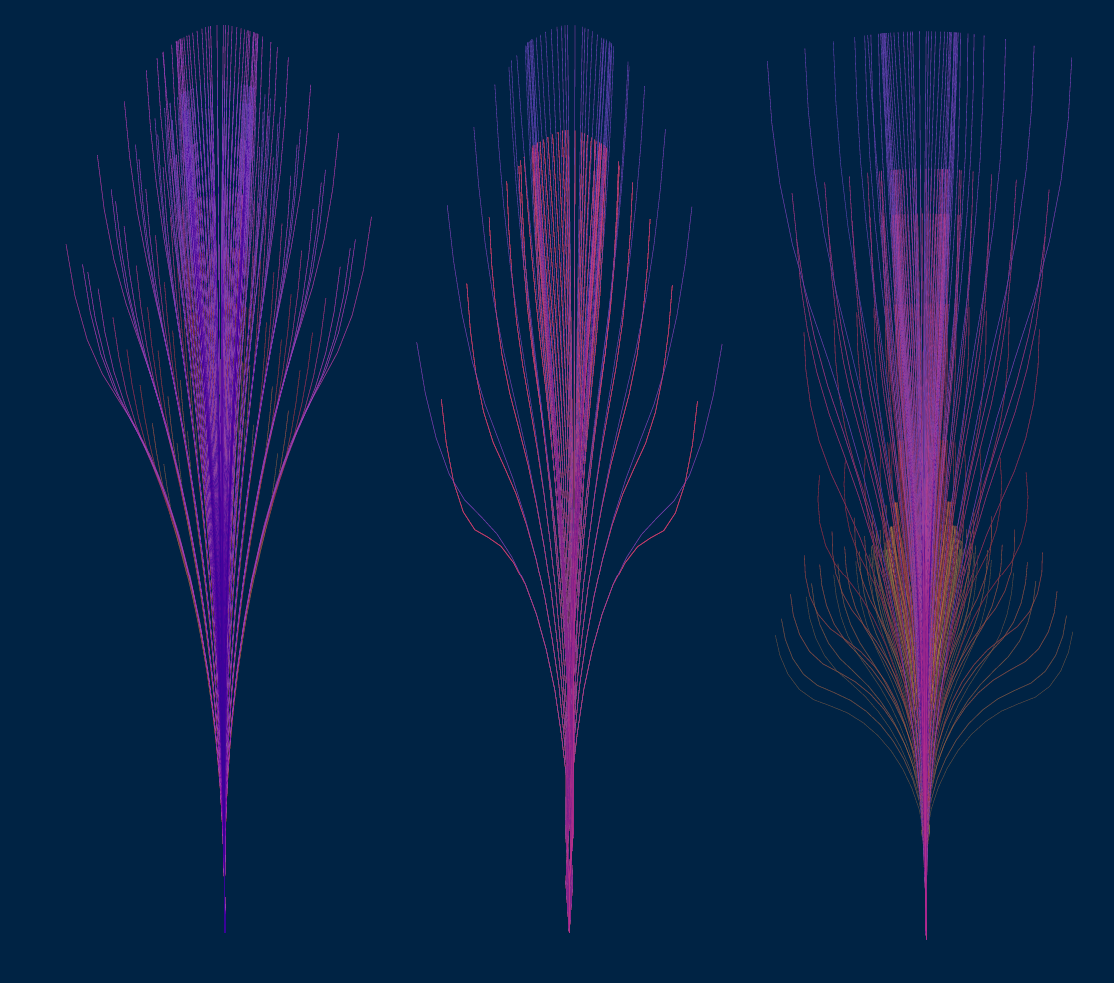
high speeds. The method uses a dynamic yaw-plane model accounting for
lateral load transfer to predict the dynamics of the vehicle in a
multi-step plan for navigation towards a goal and static obstacle
avoidance. To assess the effectivness of this new formulation, we evaluate
its performance against a reference model predictive controller in two
obstacle avoidance tests using high-fidelity multibody vehicle simulation.
@article{sirangelo_2026multistepdynamic,title={
A multi-step dynamic window approach planner for Ackermann-steered vehicles
},author={Sirangelo, Dario and Balling, Ole},year={2026},month=may,journal={International Journal of Vehicle Performance (IJVP)},}
February
Doctoral thesis
A Simulation-Driven Approach to the Development and Verification of
Autonomous Vehicle Systems
Dario
Sirangelo†
Aarhus University Graduate School of Technical Sciences (GSTS), Aarhus Feb 2026
Autonomous vehicle simulation is a rapidly-growing tool for developing
advanced driver-assistance systems (ADAS) and autonomous navigation
technologies. While much of its potential remains untapped, its importance
and adoption are expected to increase apace with the maturity of the
available simulation tools.
This dissertation investigates the current role of these systems in the
development and verification of autonomous technologies, with a particular
focus on publicly available tools. It adopts a bottom-up approach,
encompassing the instrumentation of the reference physical systems, the
modeling of their digital counterparts, and their role in the development
and verification of algorithms for autonomous operation.
The analysis focuses on three selected capabilities of an autonomous
navigation stack: first, the generation of navigation maps and paths using
vehicle mobility data; second, the formulation and verification of
model-based obstacle avoidance algorithms; and third, vehicle tracking
strategies in a lead-vehicle following scenario, assessed within the same
methodological framework. For each feature, a corresponding method is
proposed and detailed, the associated challenges are highlighted, and
results are verified through a combination of physical and simulated
experiments.
We find that high-fidelity simulation of autonomous vehicles can serve as a
powerful tool for guiding engineers in algorithm design and for the initial
verification of autonomous navigation performance, particularly when
leveraged through systematic and parallelizable computational experiments.
Furthermore, we find that the simulation-to-reality gap, a well-recognized
challenge that can stem from inadequate model definition and calibration,
while critical to address for validation purposes, does not diminish the
benefits of these tools for informing capabilities development and enabling
early-stage assessment of autonomous navigation algorithms.
This work advances the informed use of modeling and simulation in
autonomous vehicle research by consolidating a curated set of lessons
learned from both physical experimentation and simulation-based studies,
and by releasing a suite of publicly available software tools intended to
support and accelerate future research efforts.
@thesis{sirangelo_2026simulationdrivenapproach,title={
A Simulation-Driven Approach to the Development and Verification of
Autonomous Vehicle Systems
},author={Sirangelo, Dario},year={2026},month=feb,location={Aarhus},school={Aarhus University Graduate School of Technical Sciences (GSTS)},}
January
Technical report
Mobility Assessment Methods and Tools for Autonomous Military Ground
Systems
Autonomous ground systems are a key part of the future military strategy
for many NATO Nations, and industry is racing to develop them to be first
to market. In this race to field these systems, there is still a lack of
understanding of the capabilities and reliability of these systems. One key
performance measure of autonomous ground systems is their mobility on-road
and off-road. If fully autonomous systems are intended to ultimately
function without human intervention, they do not exist yet. Nevertheless,
it is important to anticipate these advances by defining methods and tools
to assess such performance measures. Modeling and simulation capabilities
are of high importance because they have the potential to significantly
improve use and performance of autonomous vehicles. The new tools will
apply to a broad class of vehicles and could yield a new paradigm for
ground vehicle autonomous mobility, allowing the possibility of modeling
autonomous complex vehicle maneuvering with high fidelity. Therefore, it is
NATO-critical to set up standard methods and tools to assess military
autonomous vehicles and to confirm their ability to fulfill strategical
maneuvers and wider operations in a quantitative manner, especially since
the military context provides challenging situations, both environmental
(multiple terrain types, varying weather and illumination conditions) and
vehicular (various military ground platforms with specific
characteristics), as well as strategic (including tactical and combat
configurations). The primary objectives of the Research Task Group NATO
AVT-341 are to develop an integrated modeling and simulation framework for
assessing autonomous mobility with high fidelity using physics-based
approaches and demonstrate in a military relevant operational scenario.
@article{ewing2026mobilityassessmentmethods,title={
Mobility Assessment Methods and Tools for Autonomous Military Ground
Systems
},author={Ewing, Jordan and Paramsothy, Jayakumar and Modungwa, Dithoto and al., et},year={2026},month=jan,journal={NATO Science and Technology Organization Technical Reports},doi={10.14339/STO-TR-AVT-341},url={https://about:blank},https://publications.sto.nato.int/publications/STO%20Technical%20Reports/STO-TR-AVT-341/TR-AVT-341-ALL.PDF},}
2022
November
Abstract
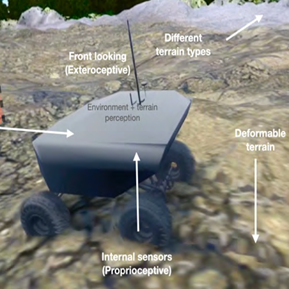
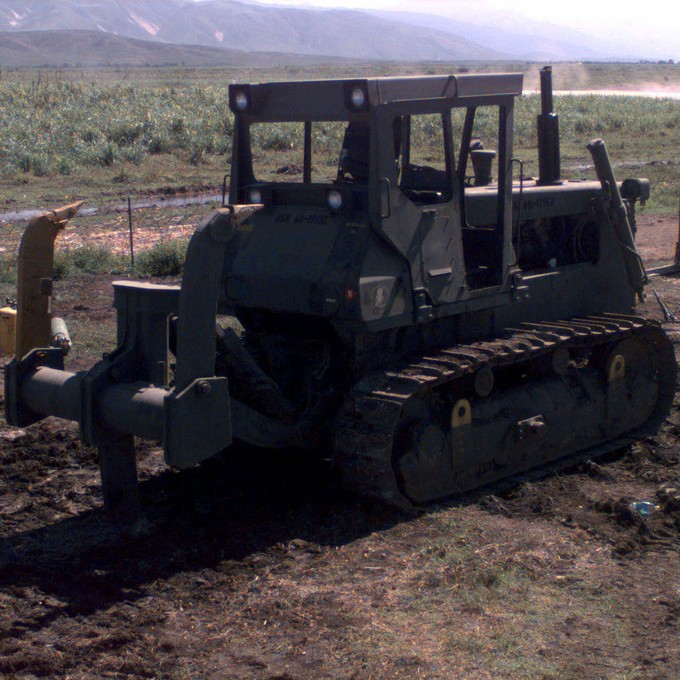
Drawbar Pull Testing for Machine-Soil Interaction Characterization
@article{balling_2022drawbarpulltesting,title={Drawbar Pull Testing for Machine-Soil Interaction Characterization},author={Balling, Ole and Sirangelo, Dario},year={2022},month=nov,journal={Advances and Innovations in Agricultural Engineering: 4th NJF - Agromek},location={Herning},url={https://www.nmbu.no/forside/agromek},}

 Drawbar Pull Testing for Machine-Soil Interaction CharacterizationAdvances and Innovations in Agricultural Engineering: 4th NJF - Agromek, Herning Nov 2022